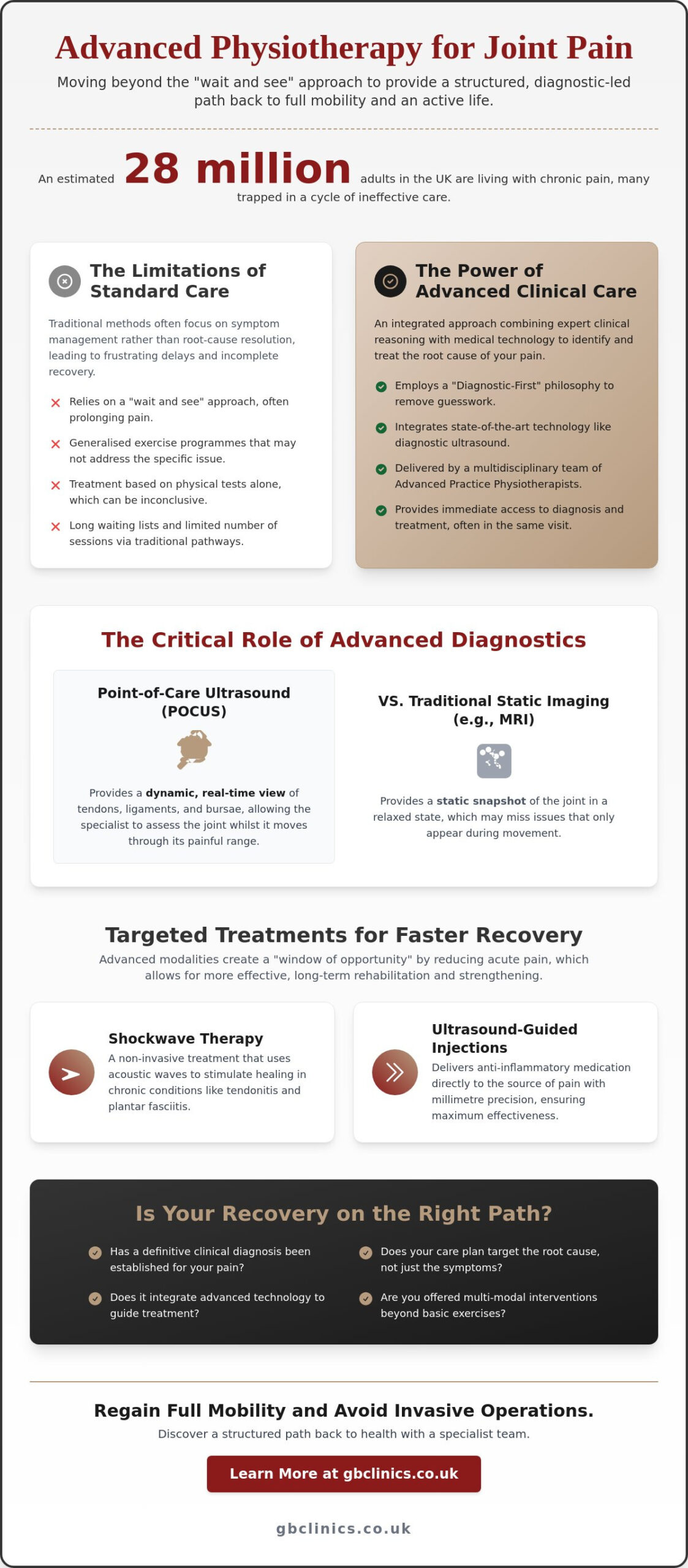
If you have spent months managing persistent discomfort whilst waiting for a specialist MSK assessment, you are not alone; an estimated 28 million adults in the UK are currently living with chronic pain. Many patients find themselves trapped in a cycle of basic stretches and “wait and see” advice that fails to address the root cause of their symptoms. However, advanced physiotherapy for joint pain offers a sophisticated alternative to standard rehabilitation. It moves beyond simple exercise sheets to provide a diagnostic-led framework that integrates clinical expertise with high-level medical technology.
You might be wondering if your current treatment is sufficient or if surgery is your only remaining option. We understand the frustration of feeling stuck in your recovery journey, especially when previous sessions haven’t delivered the results you expected. This guide will clarify the distinction between traditional methods and advanced clinical care, providing you with a specialist checklist to evaluate your treatment path. You will discover how access to precise diagnostics and treatments, such as shockwave therapy or guided injections, can help you regain full mobility and return to the activities you love without the need for invasive operations.
Key Takeaways
- Learn how advanced physiotherapy for joint pain moves beyond basic exercises by integrating expert clinical reasoning with state-of-the-art diagnostic technology.
- Understand why a diagnostic-first philosophy is the most critical step in moving past the “wait and see” approach that often leads to persistent pain.
- Discover the role of “window of opportunity” treatments, such as ultrasound-guided injections, in reducing acute pain to allow for more effective long-term rehabilitation.
- Use our specialist recovery checklist to assess if your current care plan includes the multi-modal interventions required for a full return to mobility.
- Explore how a combined approach to diagnostics and physiotherapy can provide a structured path back to health without the need for surgical operations.
What is Advanced Physiotherapy for Joint Pain?
Advanced physiotherapy for joint pain is not merely a collection of exercises or a list of stretches. It represents a sophisticated integration of high-level clinical reasoning, medical technology, and a diverse range of interventions. Whilst standard care often focuses on managing immediate symptoms, the advanced approach prioritises root-cause resolution. It’s particularly vital for patients living with complex conditions such as osteoarthritis or chronic tendonitis, where a simple “wait and see” strategy often leads to further degeneration. In a private specialist setting, this care is delivered by a multidisciplinary team (MDT). These professionals combine their expertise to ensure every patient receives a personalised recovery path. By utilising diagnostic tools alongside manual therapy, they can bypass the limitations of traditional rehabilitation and focus on long-term joint health.
The Evolution of Musculoskeletal Care in the UK
The way we approach musculoskeletal health has changed significantly over the last few decades. Historically, Physical therapy was often associated with passive treatments like heat packs or basic massage. Today, the profession has evolved into an evidence-based discipline focused on detailed biomechanical assessment and functional restoration. In the UK, Advanced Practice Physiotherapists (APPs) now operate at a level of clinical authority similar to medical consultants. They possess the specialised skills required to request imaging, interpret complex data, and perform clinical procedures. For many patients, the traditional GP-to-Physio pathway involves frustratingly long waiting lists and a limited number of sessions. Private specialist centres offer an efficient alternative, providing immediate access to expert clinicians who can often diagnose and initiate treatment within the same appointment.
Standard vs. Advanced: Key Differentiators
Understanding the difference between standard care and advanced physiotherapy for joint pain is crucial for achieving long-term recovery. Standard physiotherapy typically involves generalised exercise programmes and passive modalities. Whilst these are helpful for minor injuries, they often fall short when dealing with persistent or degenerative joint issues. Advanced practice incorporates sophisticated tools such as diagnostic ultrasound, which allows for a real-time view of the joint’s internal structures. It also integrates shockwave therapy and ultrasound-guided injections to target inflammation directly at its source. These practitioners are highly trained to identify “red flags” or complex comorbidities, ensuring that even the most difficult cases are managed with clinical precision. This blend of modern technology and expert reasoning creates a robust framework for active recovery, helping patients avoid the need for surgical operations.
The Diagnostic Checklist: Why “Wait and See” Fails
Establishing a definitive clinical diagnosis isn’t just a preference; it’s a clinical necessity. Many patients are told to rest or try basic exercises without knowing exactly what is happening inside their joint. This “wait and see” approach often leads to chronic changes, muscle wasting, and months of lost time. Advanced physiotherapy for joint pain changes this trajectory by prioritising objective data from the very first appointment. At specialist centres such as GB Clinics, the “Diagnostic-First” philosophy ensures that we aren’t just treating where it hurts, but why it hurts. This approach removes the guesswork that often leads to treatment failure in standard settings.
While traditional physical tests are the foundation of any assessment, they have inherent limitations. Deep-seated joint issues, subtle inflammatory changes, or small structural tears can be difficult to pinpoint through touch and movement alone. Clinical tests for the shoulder or hip, for instance, can sometimes be inconclusive due to the complexity of overlapping tissues. By integrating advanced technology into the initial consultation, clinicians can bypass the uncertainty that often plagues standard rehabilitation and provide a clear path forward.
The Role of Point-of-Care Ultrasound (POCUS)
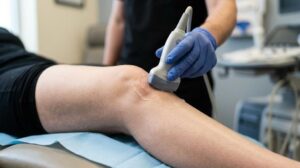
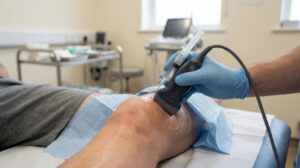
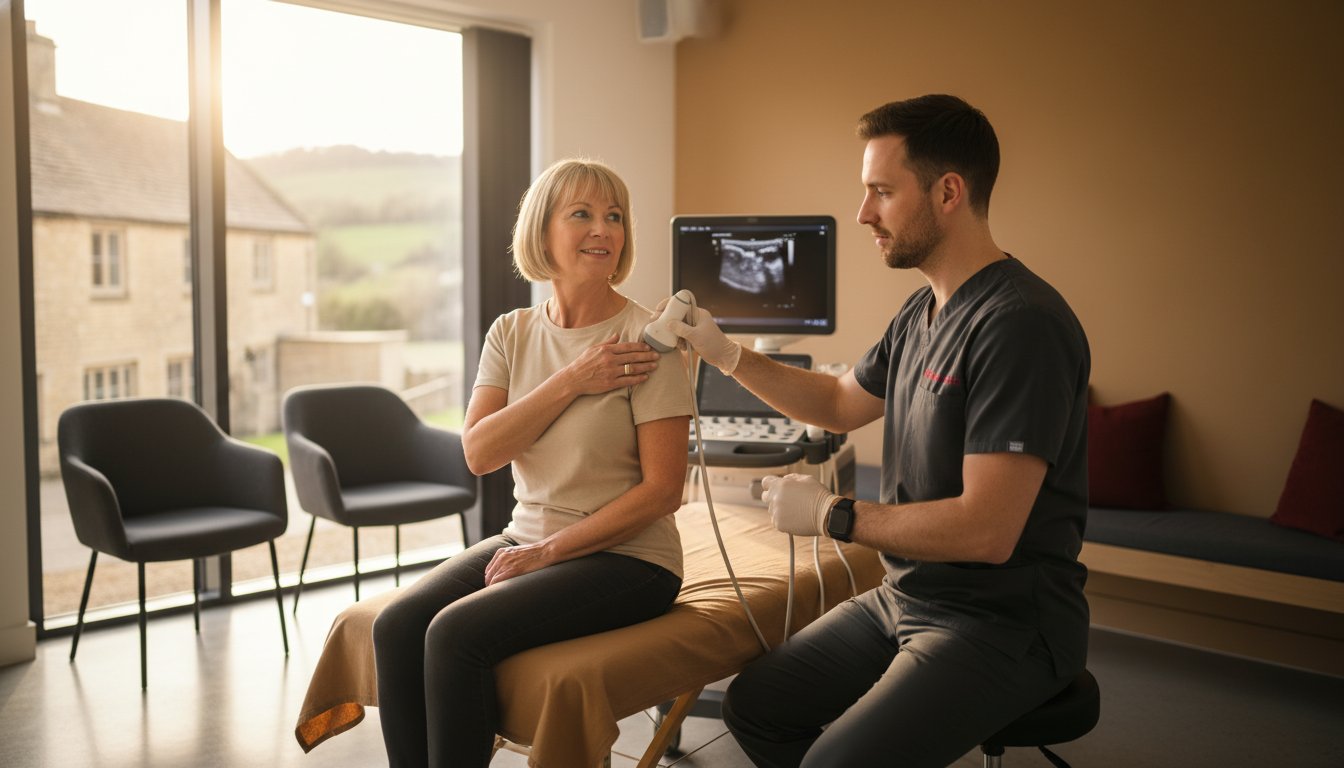
Point-of-Care Ultrasound (POCUS) provides immediate clarity by allowing clinicians to visualise tendons, ligaments, and bursae in real-time. Unlike an MRI, which provides a static snapshot of a joint in a relaxed state, ultrasound allows for dynamic scanning. This means your specialist can move the joint through its painful range whilst viewing the internal structures on a monitor. It’s an incredibly effective way to identify “catch” points or impingements that only occur during activity. This immediate feedback allows for a much faster transition to targeted treatment, such as guided injections or specific loading protocols. If you’re tired of vague advice and want to understand the root cause of your discomfort, consider booking a diagnostic-led assessment at GB Clinics to start your recovery with clinical certainty.
Biomechanical and Functional Screening
A thorough diagnostic checklist must look beyond the site of pain. A holistic, advanced view considers the entire kinetic chain to identify why a specific joint is being overloaded. For example, persistent hip pain is frequently a secondary symptom of poor foot mechanics or a stiff lumbar spine. Functional screening is the bridge between clinical diagnosis and performance recovery. A comprehensive assessment should include:
- Movement Pattern Analysis: Identifying compensatory habits that increase joint stress during daily tasks.
- Load Tolerance Testing: Determining exactly how much weight or impact the joint can currently handle without aggravating symptoms.
- Kinetic Chain Review: Assessing the joints above and below the injury site for contributing weaknesses or stiffness.
Advanced Modalities: Beyond Traditional Exercise
Recovery often stalls when pain becomes a barrier to movement. If you cannot perform your prescribed exercises due to significant discomfort, your progress will inevitably plateau. Advanced physiotherapy for joint pain utilises specific medical technologies to create what we call a “window of opportunity.” This is a strategic period where pain and inflammation are sufficiently reduced to allow for the intensive, high-level rehabilitation required for long-term joint health. By integrating these modalities, we ensure that your recovery isn’t limited by your current pain threshold.
For those experiencing acute inflammatory flares, ultrasound-guided steroid injections provide rapid relief by delivering medication with millimetre precision. This accuracy is essential; it ensures the anti-inflammatory reaches the exact source of the pain whilst avoiding healthy surrounding tissues. This is what separates standard rehab from advanced physiotherapy for joint pain. Other options, such as Hyaluronic Acid (Gel Injections), act as a lubricant and shock absorber for arthritic joints, mimicking the natural synovial fluid that has been lost over time. For chronic tendon issues like calcific tendonitis or plantar fasciitis, Shockwave Therapy offers a non-invasive way to stimulate tissue repair where traditional methods have failed.
Invasive vs. Non-Invasive Advanced Options
Choosing the right modality depends on your specific diagnosis and the stage of your injury. Shockwave Therapy is an excellent non-invasive choice for stubborn tendinopathies. It uses acoustic energy to trigger mechanotransduction, a biological process that “restarts” the healing cycle in chronic, stagnant tissues. If joint stability is the primary concern, Prolotherapy can be used to stimulate the body’s natural healing response in lax ligaments, promoting a tighter and more stable joint environment. Conversely, Guided Hyaluronic Acid Injections are often preferred for long-term management of osteoarthritis, providing a protective “cushion” that reduces friction and improves daily function.
The Synergy of Injections and Physiotherapy
It’s vital to understand that these advanced treatments are not a “cure” in isolation. They are powerful tools designed to facilitate advanced rehabilitation. An injection might settle the pain, but it doesn’t change the biomechanical patterns or muscle weaknesses that caused the issue in the first place. The real value lies in the synergy between the treatment and the subsequent loading programme. Our clinical timeline typically follows a structured path: the intervention reduces the pain, a brief settling period follows, and then we begin a phase of progressive loading. This approach allows you to perform higher-level exercises that were previously impossible, leading to a stronger, more resilient joint that is less likely to suffer a relapse.
The Joint Pain Recovery Checklist for Patients
Determining whether you are receiving the appropriate level of care is essential for a successful recovery. Many patients find themselves in a loop of repetitive sessions that offer temporary relief but fail to create lasting change. Advanced physiotherapy for joint pain is distinguished by its rigour and its refusal to rely on “wait and see” tactics. If your recovery has stalled, use the following clinical checklist to evaluate your current treatment path. A high-standard care plan should meet every one of these criteria to ensure you are moving towards full mobility rather than just managing symptoms.
- Clinical Diagnosis: Has a specific tissue or structural cause been identified through physical testing or diagnostic imaging?
- Multi-modal Approach: Does your plan combine manual therapy, advanced technology like shockwave, and structured exercise?
- Progressive Loading: Are your exercises becoming more challenging as your strength improves, or are you repeating the same routine?
- Adjunct Access: Does the clinic provide immediate access to guided injections or shockwave therapy if your progress plateaus?
- Exit Strategy: Is there a clear timeline for your recovery and a plan to maintain your joint health long-term?
Evaluating Your Current Treatment Plan
One of the most significant red flags in rehabilitation is a lack of progression. If you have been performing the same three stretches for six weeks without a measurable change in your symptoms, your treatment is likely insufficient. Recovery depends on effective load management. This involves understanding exactly how much stress your joint can safely handle and gradually increasing that limit. Whilst “hands-on” treatments like massage or mobilisation are excellent for reducing pain in the short term, they are support tools rather than the entire solution. They should be used to create a window where you can perform the movements necessary for actual tissue repair. If you are concerned that your current care is lacking these elements, you can book an advanced assessment at GB Clinics to receive a comprehensive clinical review.
Questions to Ask Your Specialist
Empowering yourself with the right questions can significantly change your treatment outcome. During your next appointment, ask your clinician for specific details regarding your pathology and the reasoning behind your programme. Clear communication is a hallmark of specialist care. Consider asking the following:
- “What is the specific tissue at fault, and what clinical evidence determined this?”
- “If we don’t see a measurable improvement in my function within four weeks, what is our Plan B?”
- “How do my overall biomechanics and movement patterns contribute to this recurring joint pain?”
A specialist in advanced physiotherapy for joint pain will be able to answer these questions directly, providing a logical progression for your care. This transparency builds the trust necessary for a dedicated recovery journey.
Specialist MSK Care in Oxfordshire: The GB Clinics Approach
For patients seeking advanced physiotherapy for joint pain in Oxfordshire, GB Clinics offers a dedicated environment focused entirely on musculoskeletal excellence. Unlike the often institutional and hurried atmosphere of large hospitals, our centre provides a sophisticated blend of clinical authority and personalised care. We believe that recovery is most effective when high-level medical technology is delivered with a human touch. By housing both diagnostic ultrasound and advanced rehabilitation services under one roof, we eliminate the fragmented care often found in traditional healthcare pathways. This integrated model ensures that your clinician has a complete, real-time understanding of your pathology from the moment you walk through our doors.
The journey at our Oxfordshire clinic is designed for efficiency and clinical precision. It begins with a comprehensive consultation where we listen to your history and perform a detailed physical assessment. If required, a diagnostic scan is conducted during the same appointment to visualise the internal structures of the joint. This immediate clarity allows us to move straight into an integrated treatment plan. Whether you require ultrasound-guided injections to settle inflammation or a structured loading programme to rebuild strength, every step is coordinated by a team that understands your specific recovery goals.
Our Advanced Physiotherapy and Rehabilitation Services
Our clinical offerings are designed to manage even the most complex musculoskeletal conditions. We specialise in treating stubborn issues such as Greater Trochanteric Pain Syndrome (GTPS) and chronic knee osteoarthritis, which often require more than just standard exercise. Our services include:
- Shockwave Therapy: A non-invasive intervention for chronic tendon pain and calcification.
- Sports Massage: Targeted manual therapy to manage soft tissue tension and support recovery.
- Advanced Physiotherapy: Evidence-based rehabilitation that bridges the gap between pain relief and full functional performance.
The convenience of local, specialist care in Oxfordshire means that patients no longer need to travel to major cities to access elite-level MSK services. We provide a private, professional setting where your recovery is our primary focus.
Your Path to Recovery Starts Here
Choosing a specialist pain clinic over a generalist provider ensures that you are working with experts who deal with complex joint issues every single day. Our commitment is rooted in non-surgical interventions and active recovery, helping you avoid the risks and lengthy downtime associated with operations. We provide the tools, the technology, and the expertise required to help you regain your mobility and confidence. If you are ready to move past persistent discomfort and follow a structured, diagnostic-led path to health, you can book a specialist consultation at GB Clinics today. Experience the difference that advanced physiotherapy for joint pain can make to your quality of life.
Secure Your Path to Active Recovery
Achieving a full recovery requires moving beyond the “wait and see” approach of standard care. By prioritising a diagnostic-first philosophy, you gain the clinical certainty needed to address the root cause of your discomfort. We have explored how the integration of expert clinical reasoning and medical technology creates a robust framework for rehabilitation. Advanced physiotherapy for joint pain is not just about exercises; it’s about a coordinated journey that uses precision tools to bypass the limitations of chronic pain.
Our Oxfordshire clinic provides immediate access to expert-led diagnostic ultrasound, state-of-the-art shockwave therapy, and a specialist guided injection clinic. These interventions are designed to prime your body for a successful, non-surgical recovery. You don’t have to navigate persistent pain alone; a structured and professional plan is within reach.
Book your specialist MSK assessment at our Oxfordshire clinic today to begin your personalised journey back to full mobility. We look forward to supporting your return to the activities you love with confidence and strength.
Frequently Asked Questions
How is advanced physiotherapy different from what I get on the NHS?
Advanced physiotherapy differs from NHS care primarily through immediate access to specialised diagnostics and a wider range of treatment modalities. Whilst the NHS often relies on a triage-based approach with basic exercise sheets, advanced care integrates point-of-care ultrasound and technology like shockwave therapy from the outset. This allows for a more precise, root-cause diagnosis and a faster transition into targeted rehabilitation without the 4 to 12 week waiting times often seen in public services.
Do I need a GP referral to visit a private pain clinic in Oxford?
No, you don’t need a GP referral to visit our private pain clinic in Oxford. We accept self-referrals, allowing you to bypass long primary care waiting lists and access specialist MSK assessments immediately. This direct access is a hallmark of advanced physiotherapy for joint pain, ensuring that your recovery journey begins without unnecessary administrative delays. If you have private medical insurance, it’s always worth checking if your provider requires a GP signature for claim authorisation.
Can advanced physiotherapy help me avoid joint replacement surgery?
Advanced physiotherapy can often help patients avoid or significantly delay joint replacement surgery by improving joint mechanics and managing inflammation. By using guided injections to settle pain and progressive loading to strengthen supporting tissues, we can restore function in joints affected by moderate to severe osteoarthritis. Our goal is to provide a robust, non-surgical alternative that allows you to maintain an active lifestyle whilst preserving your natural joint for as long as possible.
Is diagnostic ultrasound included in a standard physiotherapy assessment?
Diagnostic ultrasound is not typically included in a standard physiotherapy assessment. Most generalist clinics rely solely on physical tests and palpation to form a diagnosis. At specialist centres, point-of-care ultrasound is often integrated into the initial consultation. This advanced tool provides a real-time view of tendons and ligaments, offering a level of clinical certainty that physical testing alone cannot achieve. It’s a key differentiator in advanced physiotherapy for joint pain.
How many sessions of advanced physiotherapy will I likely need for joint pain?
The number of sessions required varies depending on the complexity and duration of your joint pain. Most patients see significant functional improvements within four to six sessions when following a multi-modal plan. Acute issues may resolve faster, whilst chronic conditions like long-term tendonitis might require a longer period of progressive loading. We provide a clear clinical timeline at your first appointment so you know exactly what to expect from your recovery journey.
What happens if physiotherapy alone is not enough for my joint pain?
If physiotherapy alone isn’t providing the desired results, we integrate adjunct therapies to overcome the plateau. This might include ultrasound-guided steroid or hyaluronic acid injections to reduce debilitating inflammation. Alternatively, shockwave therapy can be used to stimulate healing in stubborn soft tissues. Because we operate as a comprehensive pain clinic, we can adjust your treatment plan internally to ensure you continue making progress toward your mobility goals without needing an external referral.
Is shockwave therapy painful, and is it suitable for all joints?
Shockwave therapy can be slightly uncomfortable, but it’s generally well-tolerated and only lasts for a few minutes. Most patients describe the sensation as a deep, rhythmic pulsing. It is particularly effective for large joints and tendons, such as the shoulder, hip, and ankle. Whilst it isn’t suitable for every clinical situation, it’s a powerful tool for treating calcific tendonitis and plantar fasciitis where traditional manual therapy has failed to deliver results.
Can I have a steroid injection and physiotherapy on the same day?
We generally recommend a short settling period of 48 hours after a steroid injection before beginning intensive physiotherapy. This allows the medication to distribute effectively and reduces the risk of post-injection flare-ups. However, a light assessment or gentle movement guidance can often occur on the same day. Your specialist will provide a specific timeline based on the type of injection you receive, ensuring your rehabilitation starts at the safest and most effective moment.